
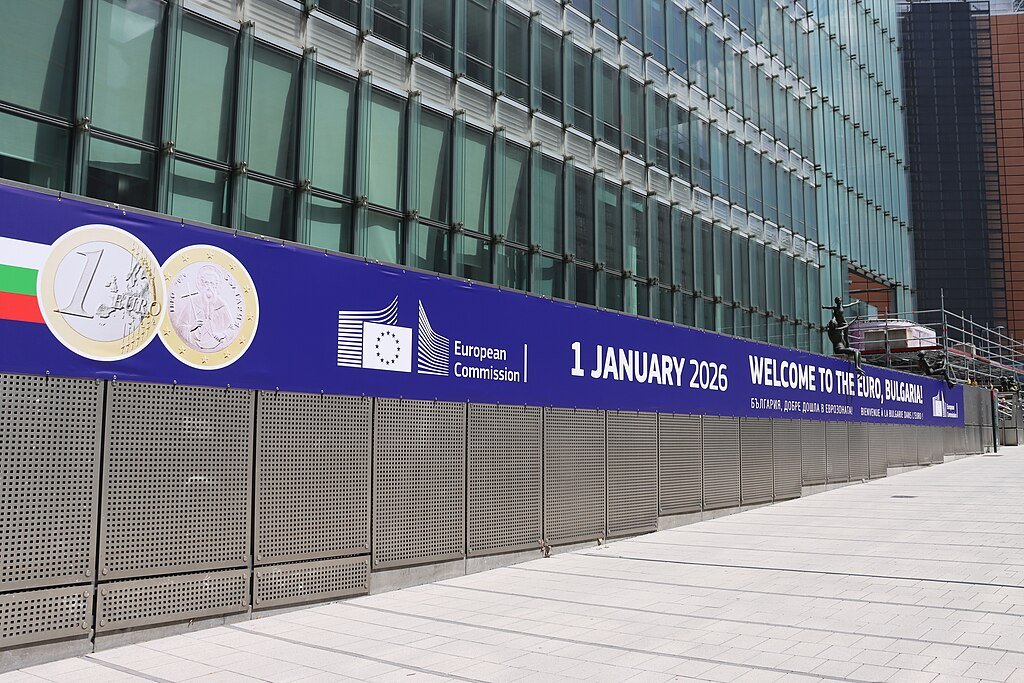
Bulgaria joins the Eurozone, becoming the 21st member of the eurozone and closing a chapter that began nearly two decades ago when the country joined the European Union. The transition, which took effect on January 1, replaces the Bulgarian lev—a national currency in use since the late 19th century—with Europe’s common currency, marking one of the most consequential economic shifts in the country’s modern history.
The change was celebrated symbolically in Sofia, where illuminated images of Bulgarian euro coins appeared on the central bank’s headquarters as citizens gathered in subzero temperatures to welcome the new year. European leaders also marked the occasion, describing Bulgaria’s entry as a milestone for both the country and the euro area as a whole.
Bulgaria joins the Eurozone after a long journey
Bulgaria’s path to the euro has been unusually long and complex. Although the country joined the EU in 2007, full monetary integration required years of reforms, fiscal discipline, and inflation control. Since 1997, Bulgaria has operated under a currency board, effectively pegging the lev to the euro—a system that already limited national monetary independence but provided financial stability after a severe banking crisis in the 1990s.
Supporters of euro adoption argue that the move formalizes a reality that has existed for decades. Bulgaria’s economy has effectively been tied to the euro, without enjoying the full benefits of eurozone membership such as access to ECB liquidity mechanisms, lower transaction costs, and greater investor confidence.
Economic and Strategic Benefits
Successive Bulgarian governments have consistently backed euro adoption, presenting it as a strategic decision rather than a symbolic one. Officials argue that eurozone membership will:
- reduce borrowing costs for the state, businesses, and households,
- improve Bulgaria’s credit rating and attractiveness to foreign investors,
- eliminate currency exchange risks for trade with EU partners,
- strengthen financial supervision and banking stability,
- and deepen Bulgaria’s integration into core EU institutions.
With a population of roughly 6.4 million, Bulgaria remains the poorest country in the EU by GDP per capita, making economic convergence a central political objective. Policymakers see the euro as a tool to accelerate long-term growth rather than a short-term fix.
Geopolitically, euro adoption is also viewed as a way to anchor Bulgaria more firmly within Western economic structures, reducing vulnerability to external pressure and reinforcing its role within the EU at a time of heightened regional instability.
Public Anxiety Over Prices and Living Standards
Despite the official optimism, public opinion has long been divided. Many Bulgarians fear that switching to the euro will lead to price increases without corresponding wage growth, a concern rooted in the experiences of other countries that joined the eurozone during periods of high inflation.
In the weeks leading up to the changeover, markets and shops displayed prices in both levs and euros, a dual-pricing system designed to prevent hidden price hikes. Still, skepticism remains widespread.
Residents interviewed in Sofia expressed concerns that everyday goods could become less affordable, particularly for pensioners and low-income households. Others, however, argued that fears are exaggerated and that most eurozone countries ultimately adapted without lasting damage to living standards.
Political Tensions and a Divided Society
The euro transition also exposed deeper political and institutional tensions. In a nationally televised address shortly before the changeover, President Rumen Radev described the euro as the final step in Bulgaria’s EU integration but criticized the lack of a public referendum on the issue.
According to him, the absence of a direct vote reflected a growing disconnect between political elites and society—a gap highlighted by mass protests and years of political instability. Bulgaria has held eight elections in five years, underscoring chronic governance challenges that continue to shape public trust.
The euro adoption comes just weeks after anticorruption protests led to the collapse of a conservative-led government, once again pushing the country into political uncertainty.
A Moment of Transition, Not Closure
For many Bulgarians, the euro represents both promise and risk. Some see it as a symbol of belonging to the European core, while others worry it may amplify social inequalities if not accompanied by strong consumer protections and wage growth.
Yet even among skeptics, there is recognition that Bulgaria’s economy has long operated in the euro’s shadow. As one retiree in Sofia put it: “The whole of Europe has managed with the euro. We’ll manage too.”
The real test will not be the currency itself, but whether Bulgaria can translate eurozone membership into higher incomes, stronger institutions, and sustained economic convergence with the rest of the EU.
Featured Image FrDr, CC BY-SA 4.0, via Wikimedia Commons
