
Last Updated on November 19, 2025
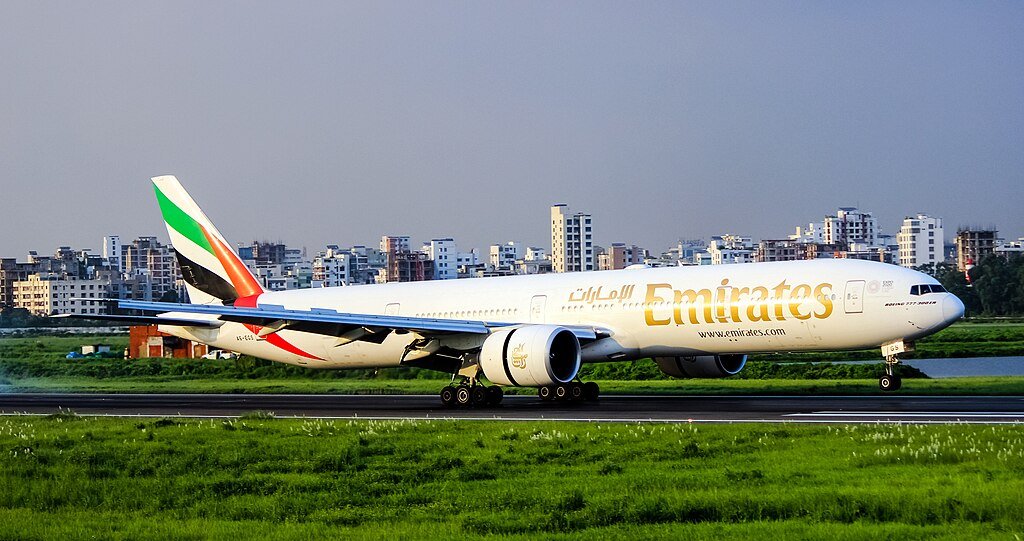
Dubai-based airline Emirates announced on Monday a new order for 65 additional Boeing 777-9 aircraft, strengthening its role as the world’s biggest buyer of wide-body jets. The new order — revealed at the Dubai Airshow — brings Emirates’ total commitment to the 777X family to 270 aircraft.
But the deal came with an important condition: Boeing agreed to conduct a feasibility study for an even larger variant, potentially creating the biggest twin-engine passenger jet ever built.
Emirates valued the order at $38 billion, though analysts note that large carriers typically receive sizeable discounts on bulk purchases.
A Push for the Boeing 777-10
The most intriguing part of the agreement is Emirates’ support for exploring a new Boeing 777-10, an extended version of the 777X designed to seat around 450 passengers in a two-class layout.
This model is currently undergoing preliminary assessments and would bridge the gap left after Airbus discontinued the A380 programme.
The deal also gives Emirates flexibility: it can convert some of its 777-9 orders into the proposed 777-10 should Boeing proceed, or into the smaller 777-8.
Why Emirates Wants Bigger Jets Again
After Airbus ended A380 production in 2021 due to weak demand from most airlines, Emirates — the world’s largest A380 operator — has consistently urged manufacturers to develop high-capacity, fuel-efficient wide-body jets.
The carrier needs aircraft capable of handling its busiest long-haul routes, where peak travel volumes still exceed what current twin-engine models can handle efficiently.
Boeing’s Challenges: Delays, Quality Problems, and the Road Ahead
Boeing did not offer additional comments on the proposed 777-10, partly because the company is already dealing with significant challenges:
Major Recent Issues at Boeing
- Certification delays: The 777-9 is seven years behind schedule, now expected to enter service in 2027.
- 737 MAX incidents: Ongoing scrutiny intensified after the January 2024 Alaska Airlines door-plug blowout, which triggered investigations into Boeing’s quality control and manufacturing processes.
- Supply-chain constraints: Shortages of engines, fuselage components, and qualified labour have slowed output.
- Regulatory pressure: Both FAA and EASA have tightened oversight, demanding stronger safety management systems and more transparency.
Boeing’s Plans for the Future
- Strengthening quality control across factories in Washington and South Carolina.
- Gradually increasing production rates for the 737 MAX and 787 Dreamliner by late 2025.
- Prioritising certification of the full 777X family, hoping the 777-9 will restore confidence in Boeing’s wide-body programme.
- Investing in advanced composites and next-gen propulsion research for a future “New Midsize Airplane”.
Industry Hesitation Remains
Both Boeing and Airbus have expressed doubts about global demand for ultra-large jets after the slow sales of the Boeing 747-8 and the end of the A380.
However, Emirates’ pressure — and potentially similar requests from other major airlines — could persuade Boeing to green-light the 777-10.
For now, attention at the Dubai Airshow centers on whether Emirates will also place new orders for the Airbus A350, and what concessions it may expect from the European manufacturer in return.
Featured Image by Md Shaifuzzaman Ayon, CC BY-SA 4.0 https://creativecommons.org/licenses/by-sa/4.0, via Wikimedia Commons