
Last Updated on October 29, 2025
China’s ambition to compete head-to-head with Boeing and Airbus through its first domestically developed passenger jet, the COMAC C919, is hitting fresh turbulence. Despite years of state support and engineering progress, the country’s flagship aviation program now faces major supply chain and political challenges that could slow its global rollout.
A Promising Challenger to the Boeing 737 and Airbus A320
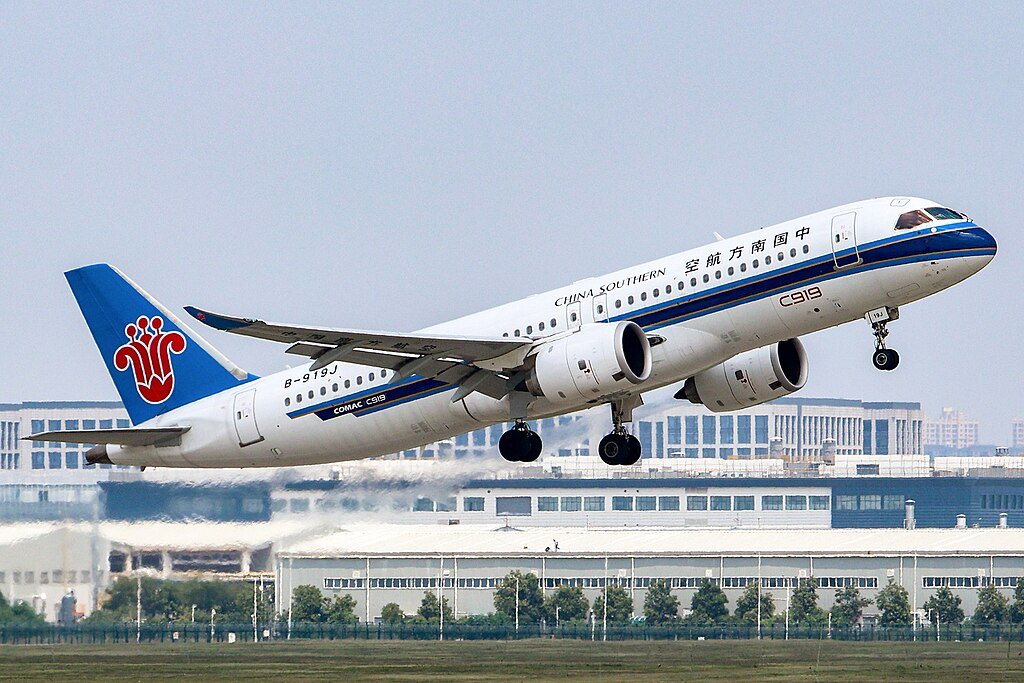
The C919, produced by the Commercial Aircraft Corporation of China (COMAC), is designed to rival the Boeing 737 MAX and Airbus A320neo families — two of the most popular aircraft in the world. While the jet symbolizes China’s technological rise, it still depends heavily on foreign suppliers for critical components.
According to Bank of America analysts, the C919 currently relies on 48 major suppliers from the United States, including GE Aerospace, Honeywell, and Collins, plus 26 from Europe and only 14 from China. This heavy dependence leaves COMAC vulnerable to geopolitical tensions, especially as export restrictions tighten between Washington and Beijing.
Trade Tensions and Technology Restrictions
In 2025, renewed U.S. trade restrictions on “critical” aviation software and components added new uncertainty. The Trump administration has hinted at extending export controls in response to China’s tighter rules on rare-earth metal exports, a move that threatens the aircraft’s production schedule.
As Max Zenglain, senior economist at The Conference Board, explained:
“COMAC faces considerable risks from political instability. Its supply chains remain highly exposed to export controls and retaliatory trade measures between the U.S. and China.”
The LEAP-1C engines, jointly developed by GE Aerospace and France’s Safran, require U.S. export licenses, which were briefly suspended in mid-2025 before being restored. Analysts like Dan Taylor of IBA Consulting say this makes the C919 “inherently sensitive to political shifts.”
Production Goals Fall Short
COMAC delivered just seven C919 aircraft in 2025, far below its planned target of 30, and only 13 in 2024. Production delays stem from both supply chain disruptions and the complex certification process needed to meet international standards.
Currently, only China’s three largest state-owned carriers — Air China, China Eastern, and China Southern — operate around 20 C919s in total. Although AirAsia and several Southeast Asian airlines have expressed interest, the lack of international certification still limits the jet’s global reach.
China’s Aviation Dream vs. Global Reality
China’s aviation market is projected to become the largest in the world by 2030, requiring more than 9,000 new aircraft over the next two decades. That demand has fueled COMAC’s growth — but the journey to match Boeing and Airbus remains long.
For comparison, Airbus and Boeing delivered a combined over 1,200 aircraft in 2024, whereas COMAC’s annual output is expected to stay below 50 for several more years.
Still, China’s state-driven industrial strategy — including massive subsidies, technology partnerships, and domestic procurement mandates — ensures that COMAC remains a strategic priority.
A Global Context: Europe, the U.S., and China’s Push for Independence
While the U.S. and EU continue to dominate civil aviation, both have grown increasingly cautious about China’s ambitions. European governments have backed Airbus’ expansion in hydrogen and electric propulsion, while the U.S. supports Boeing’s supply chain diversification away from Asia.
China, on the other hand, views the C919 not only as a commercial project but also as a symbol of technological independence — part of its broader strategy to reduce reliance on Western systems amid a fragmenting global economy.
Interesting Fact: The Race for Next-Generation Aircraft
The C919’s development reflects a larger global race toward greener and more efficient aircraft. Airbus plans to introduce a hydrogen-powered plane by 2035, while Boeing is investing heavily in AI-assisted flight systems. COMAC, for its part, has already begun conceptual work on a wide-body jet — the CR929 — in partnership with Russia’s United Aircraft Corporation.
Final Thoughts
The COMAC C919 represents both China’s determination and the difficulties of competing in one of the most technologically demanding industries in the world. While the jet has proven capable in domestic service, political risks, certification hurdles, and supply chain dependencies could delay its full takeoff on the global stage.
Still, if COMAC succeeds in achieving technological self-sufficiency and international trust, the COMAC C919 could mark the beginning of a new chapter in global aviation — one where China joins the U.S. and Europe as an equal player.
Featured image Windmemories, CC BY-SA 4.0, via Wikimedia Commons
_taking-off_from_CGO_01.jpg)
1 thought on “COMAC C919: China’s Passenger Jet Faces Trade War Turbulence”