
Last Updated on September 27, 2026
A lot of homeowners decide to convert their home to a rental property when they move, upgrade, or relocate for work. The home-to-rental transition looks straightforward on paper: you move out, a tenant moves in, and the mortgage gets covered. In reality, there are several steps to complete before you legally, financially, and operationally qualify as a landlord, and the order matters as much as the steps themselves.
The upside is real. Rental income, long-term asset appreciation, and a property that builds equity while someone else covers most of the carrying costs are genuinely powerful wealth-building tools. Before you count on any of that, you need to clear your lender’s occupancy rules, switch your insurance, handle local permits, and price the property correctly. Skipping the sequence creates expensive problems. Before you commit to anything, run your rental income scenarios through Invest Education’s free compound interest and cash flow calculators to pressure-test the numbers.
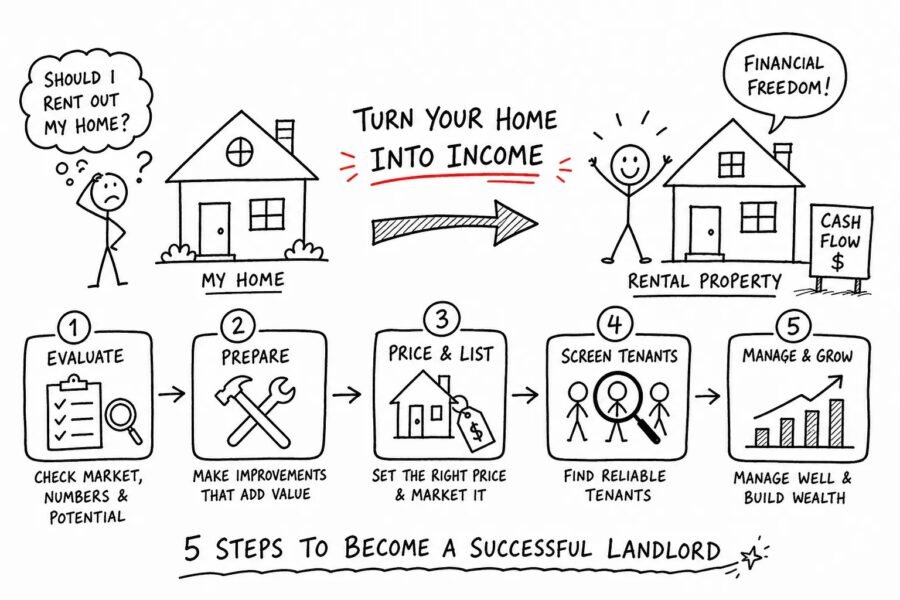
This guide walks you through each step in the right sequence, covering financial modelling, mortgage requirements, insurance, taxes, renovation costs, and tenant screening. By the end, you’ll know whether the home-to-rental conversion makes financial sense and exactly what to do first.
Home to Rental: Run the Numbers Before You Do Anything Else
The most common mistake first-time landlords make is falling in love with the idea of rental income before checking whether the property will actually cash flow. Your go/no-go decision should be grounded in a simple formula: gross rental income minus all operating expenses equals net operating income.
Operating expenses for a converted primary residence typically include several line items that are easy to under count:
- Mortgage payment (PITI)
- Landlord insurance premium
- Property taxes, if not escrowed
- A vacancy allowance of 8 to 10 percent of annual rent
- A maintenance reserve of roughly 1 percent of the property’s value per year
- A property management fee of 8 to 12 percent, if you’re not self-managing
Miss any of these and your projections will look better than reality.
Short Case Study: Projected Cash Flow
Here’s a concrete example. A home valued at $280,000 rents at $1,400 per month, producing an annual gross rental income of $16,800. That’s a gross rental yield of 6 percent, which sits close to the U.S. national average of approximately 6.56 percent according to ATTOM Data Solutions’ 2025 U.S. Rental Market Report. After applying a 9 percent vacancy allowance ($1,512), a 1 percent maintenance reserve ($2,800), and a property management fee of 10 percent ($1,680), total operating costs before the mortgage reach about $6,000 per year. Whether the remaining income covers the mortgage depends on your specific loan terms, but the exercise shows you exactly where the margin is, and where it disappears.
Two quick benchmarks help you filter a property before building a full model. The 1 percent rule, a widely used industry heuristic, not a regulatory standard, says monthly rent should equal at least 1 percent of the property’s purchase price. Positive cash flow after all realistic expenses is the second test. Neither benchmark guarantees success, but both filter out properties where the numbers clearly won’t work. You can model different rent levels and expense assumptions using Invest Education’s free rental cash flow calculator to find your break-even point before you commit.
Lender Rules for Home-to-Rental Conversions
Most conventional loans, FHA loans, and VA loans require the borrower to occupy the home as a primary residence for at least 12 months before converting to a rental. Converting earlier than the required period can trigger an occupancy clause violation, a serious mortgage breach with real legal consequences. VA and FHA loans carry stricter primary-residence requirements than conventional financing, so your loan type matters here.
How to Formally Notify Your Lender
Start by reviewing your mortgage note or deed of trust for the occupancy and change-of-use clause. Then send a written notice to your loan servicer stating that the property will be used as a rental, along with the effective date of the change. Keep a copy of the letter and any lender response in your records. Update your mailing address with the servicer if billing statements need to go to a different location.
One detail that catches homeowners off guard: Fannie Mae requires up to six months of PITI reserves in certain departing-residence scenarios where the borrower is also qualifying for a new primary residence mortgage. If you’re buying another home at the same time you’re converting your home to a rental, confirm your reserve position with your lender before you finalize either transaction.
Insurance Switch and Local Compliance Steps
A standard homeowner insurance policy can be voided or coverage disputed once tenants occupy the property, confirm the specifics with your insurer before conversion. Switching to a landlord insurance policy before anyone moves in is not optional. Landlord insurance covers lost rental income if the property becomes uninhabitable due to a covered event. Your old homeowner policy covered your own temporary living expenses in that situation, which is meaningless once you no longer live there.
Budget for the cost difference. Landlord insurance typically runs about 25 percent more than a comparable homeowner policy. Build that premium increase into your cash flow model before you finalize your rent price. Also require tenants to carry renters insurance for their own belongings, because your landlord policy does not cover tenant property.
Permits, Landlord Registration, and Local Rules
Many cities and counties require a landlord registration, rental inspection certificate, or business license before a lease can be signed. For short-term rentals, the requirements layer further: STR permits, zoning approvals, and sometimes a separate business tax certificate. The rules vary sharply by jurisdiction, so there’s no national checklist that covers every market. Search “[your city name] rental registration requirements” on the city’s official government website, then confirm the details directly with the local planning or licensing department before your first tenant moves in.
Renovation Priorities and What It Will Cost You
The goal at this stage is “rent-ready,” not “fully renovated.” Focus on safety, habitability, and anything that reduces your legal liability. For a single-family home in decent condition, budget $1,500 to $5,000 for minor repairs, safety upgrades, and a professional deep clean. Homes that need flooring replacement, full interior paint, or appliance updates can push that figure to $5,000 to $15,000.
Safety Upgrades That Landlords Legally Cannot Skip
Most states require working smoke detectors in every bedroom and hallway, carbon monoxide detectors near sleeping areas, and functional locks on all exterior doors. These aren’t optional improvements, they’re minimum habitability standards in nearly every jurisdiction. A professional pre-rental inspection identifies code compliance issues before a tenant does, and the cost is typically a small fraction of the renovation budget described above; factor it into your $1,500 to $5,000 rent-ready estimate. That’s a low-cost way to protect yourself legally and financially before the first lease is signed. Prioritize fixes that could cause injury or habitability problems over cosmetic work. Tenants care more about functional systems than fresh paint.
Tax Rules That Change the Moment You Convert Your Home to a Rental
From the date the property is placed in service as a rental, you report income and expenses on Schedule E and begin depreciating the building portion of the property. Residential rental property depreciates over 27.5 years using straight-line MACRS depreciation, per IRS Publication 527. The depreciable basis is the lower of your adjusted cost basis or the fair market value at the time of conversion, and land is excluded from depreciation entirely. If you convert partway through the year, you must allocate annual costs like property taxes and insurance between personal and rental use for that partial year.
What Happens to Your Capital Gains Exclusion
The Section 121 home-sale exclusion, which shields up to $250,000 of gain for single filers or $500,000 for married couples filing jointly, can still apply after conversion if you meet the ownership-and-use tests. The critical catch: any depreciation claimed after May 6, 1997, is not excludable and is subject to depreciation recapture, taxed at up to 25 percent federally. If you later sell at a loss, the basis used is the lower of your adjusted basis or the fair market value at the conversion date, not your original purchase price. That detail surprises many first-time landlords at tax time.
With those financial and legal foundations in place, the next step shifts from paperwork to people: finding and qualifying the right tenant.
Consult a CPA before you convert; the tax structure affects how you set rent, manage expenses, and eventually exit the property.
Screening Tenants and Setting Up Your First Lease
A solid screening process starts with a written application, then moves to a credit check, background check, income verification, and landlord references. The widely used industry guideline is to target tenants who earn at least three times the monthly rent, treat this as a practical rule of thumb rather than a regulatory floor, and adjust it based on your local market. Several platforms handle screening for independent landlords: Avail, TurboTenant, and Zillow Rental Manager all offer credit, criminal, and eviction checks at low or no cost to the landlord, with the fee often passed to the applicant instead.
Set written, objective screening criteria before you review a single application. A documented policy, for example, a written statement specifying your minimum credit score threshold and income requirements, kept on file for every applicant, keeps you compliant with the Fair Housing Act and removes ambiguity from your decision-making. If an applicant later disputes your decision, that documentation is your first line of defence.
Self-Manage or Hire a Property Manager?
Property managers typically charge 8 to 12 percent of monthly rent collected. Self-managing saves that cost but adds real time and responsibility: maintenance calls, lease renewals, and legal compliance all land on you directly. A property manager makes sense when you live far from the property, have limited bandwidth, or own multiple rentals. For a first conversion with a single unit, many owners start by self-managing and reassess after the first lease cycle.
Convert Your Home to a Rental: Put the Steps in Order
Converting a home to a rental is one of the most accessible entry points to property investing, but it only works when you follow the steps in the right sequence. Model the numbers first, clear your lender and insurance requirements, handle local permits, prep the property, understand the tax implications, and then screen tenants carefully.
The key decision point is your cash flow model. If the property can cover its costs with a realistic vacancy buffer and still show positive net income, the home-to-rental conversion makes financial sense. If it can’t, you need to know that before signing a lease, not after.
Invest Education’s free calculators let you stress-test the numbers at different rent levels and expense scenarios. Download the rental-conversion worksheet for a printable action plan you can work through from step one. Preparation is what separates homeowners who build a profitable rental from those who absorb costly early mistakes, and you now have the full roadmap. Start with the cash flow model.