
Last Updated on November 18, 2025
In mid-November, during a major corporate banking forum at the Warsaw Stock Exchange, CEO Tomasz Bardziłowski announced a milestone few believed possible just a decade ago: Poland’s economic growth has officially enabled the country to enter the world’s Top 20 largest economies.
For a country that, in 1990, ranked only 38th globally and was still struggling with the legacy of central planning, the achievement is more than symbolic — it marks the country’s arrival as a modern European economic heavyweight.
A trillion-dollar economy — and now ahead of Switzerland
According to current estimates, Poland’s GDP for 2025 stands at $1.04 trillion, a number that not only breaks the psychological barrier of one trillion but also places the country ahead of Switzerland for the first time.
This marks a dramatic shift: just 30 years ago, Poland’s GDP was less than one-tenth of the Swiss economy.
Bardziłowski described Poland’s new position as entry into an “elite club” — but stressed that maintaining this momentum will require sustained capital investment and a strong financial system.
Remarkable growth despite global uncertainty
Fresh data from the Central Statistical Office shows that Poland’s economy grew 3.7% year-on-year in the third quarter, the fastest pace in three years.
Prime Minister Donald Tusk highlighted that the country is now “growing at one of the fastest rates in Europe,” attributing the momentum to strong domestic demand and a new wave of investment.
Finance Minister Andrzej Domański added that Poland is rapidly closing the gap with countries such as Saudi Arabia and the Netherlands — a shift few analysts considered realistic even in the early 2010s.
The real engine behind Poland’s economic growth
Poland’s economic leap is the result of a combination of strategic investments, long-term policy decisions, and favorable demographics.
1. Record-high investment in infrastructure and technology
Poland has entered a new investment super-cycle:
- Over 650 billion złoty ($160 billion) is being allocated toward technology, energy transition projects, and new infrastructure.
- Expansion of highways, modernised railway networks, and upgraded energy systems are boosting productivity across the country.
- Poland has become one of Europe’s manufacturing and logistics hubs, serving as a bridge between Western Europe and the rapidly developing economies of Central and Eastern Europe.
2. A defence boom reshaping the economy
Poland now spends 4.7% of GDP on defence, the highest share in NATO — a response to regional security concerns and a major boost for the domestic industrial base.
This investment fuels local production of:
- armoured vehicles
- drones
- missile systems
- cybersecurity technologies
It also strengthens Poland’s strategic relevance within Europe.
3. A strong internal market
Unlike smaller Central European neighbours (such as Slovakia or the Czech Republic), Poland benefits from a large internal market of 38 million consumers, with incomes rising steadily for two decades.
This domestic demand has created a more crisis-resistant economy, capable of absorbing external shocks better than export-dependent countries.
Poland’s economic revolution: closing the gap with Europe’s giants
Beyond the numbers, Poland is undergoing a structural shift:
• GDP per capita approaching Western levels
While Poland still trails Germany and France, it has dramatically reduced the gap:
- In 2004 (when Poland joined the EU), its GDP per capita was around 50% of the EU average.
- In 2025, it has reached nearly 80%.
At current growth rates, economists believe Poland could surpass Italy and even approach the French level within the next decade.
• A “nearshoring magnet” for global companies
After supply chain disruptions during the pandemic, multinational firms began relocating production closer to Europe — and Poland has been one of the biggest beneficiaries.
Companies from the US, Japan, Korea, and Germany are investing in:
- electronics factories
- automotive plants (including EV batteries)
- IT and business service hubs
- renewable energy projects
• The new European tech hub
Poland now ranks among Europe’s fastest-growing tech ecosystems, with major hubs in Warsaw, Kraków, and Wrocław.
It is home to:
- over 400,000 software developers,
- multiple unicorns,
- and a booming AI and robotics sector.
Interesting facts about Poland’s economic growth
- Poland was the only EU economy to avoid recession during the 2008–2009 global financial crisis.
- It is the EU’s 6th largest economy and its most populous country in Central Europe.
- Polish exports have almost quadrupled since 2004.
- Poland now produces more electric vehicle batteries than any country outside Asia.
- The Warsaw Stock Exchange is the largest in Central and Eastern Europe.
Final Thoughts
Poland’s economic growth has not just achieved an economic milestone — it is an evidence of a country that has transformed itself in one generation paving the road to becoming as important for the European Union as the likes of Germany, France and Italy. With continued investment, a strong labor force, and accelerating innovation, Poland is on a trajectory that could reshape the economic balance not only in Eastern Europe but within the whole continent.
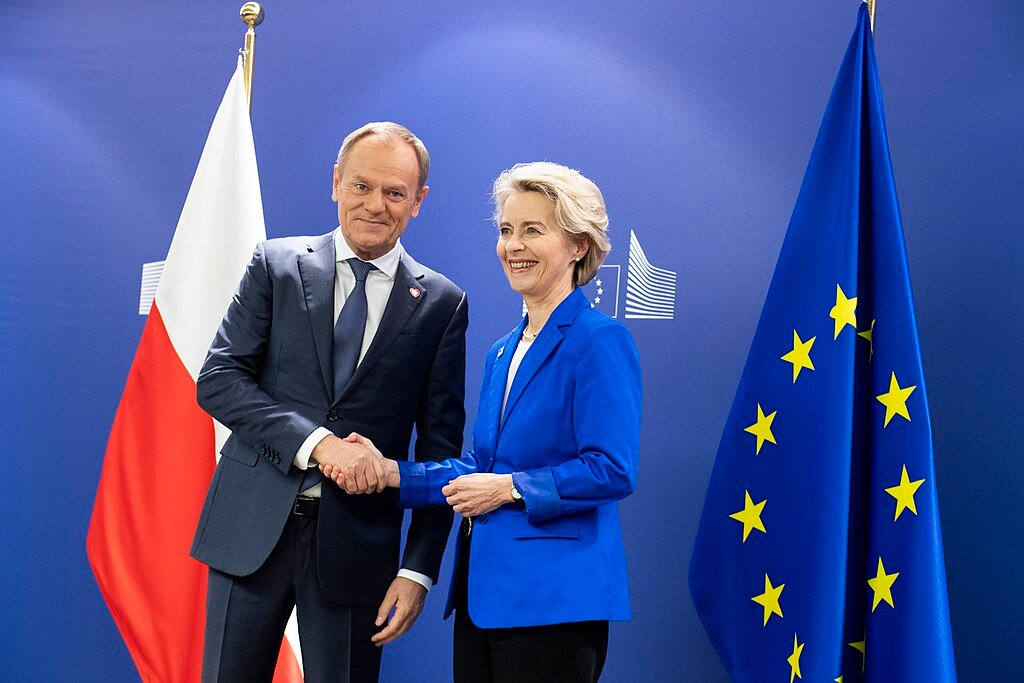
Featured Image – © European Union, 2025, CC BY 4.0 https://creativecommons.org/licenses/by/4.0, via Wikimedia Commons