
Last Updated on October 22, 2026
For a while, every time we tried to answer a reader question about artificial general intelligence, we got stuck in the same loop. The conversation would either jump straight to robots taking over the world, or it would dissolve into technical definitions that nobody could act on. Neither version helped anyone decide what to do with their savings.
That question keeps coming up in reader emails: “Should I invest in AI? Is AGI something different? What does any of this mean for my money?” This article is the answer we wish we had when we first started digging into the research. The goal is not to predict the future. The goal is to give you a clear enough picture of what artificial general intelligence actually is, what honest timelines look like in 2026, and which investment decisions are worth thinking about right now.
What artificial general intelligence actually is (and what it isn’t)
The AI you interact with every day, including spam filters, recommendation algorithms, and large language models like the ones behind popular chatbots, is narrow AI. Each system was trained for a specific job and performs well within that boundary. Think of a narrow AI as a brilliant specialist who can diagnose one disease better than any doctor alive but cannot write a prescription, make small talk, or find their car keys. The moment the task changes meaningfully, performance drops. Researchers sometimes call this category ANI, or artificial narrow intelligence, to make the distinction between narrow AI and AGI explicit.
Artificial general intelligence sits further along the spectrum. As of 2026, there is no universally accepted definition or test for AGI. OpenAI defines it as “highly autonomous systems that outperform humans at most economically valuable work,” emphasizing autonomy and economic output. Google DeepMind frames it as general intelligence comparable to human intelligence, assessed across perception, reasoning, memory, learning, attention, and social cognition. The most defensible synthesis across these approaches is an AI system that can reliably learn and perform a wide range of cognitive tasks at roughly human level, across unfamiliar domains, often with substantial autonomy.
One thing worth clarifying before we go further: AGI is not the same as superintelligence. Superintelligence would exceed human cognitive ability across all domains simultaneously. AGI is the threshold before that, where a system reaches roughly human-level versatility. Conflating the two is a quick way to end up in science fiction territory when you should be thinking about your portfolio.
Why expert timelines vary so wildly (and what that means for your horizon)
Here is where the honest answer gets uncomfortable. There is no settled date for artificial general intelligence. Demis Hassabis of Google DeepMind recently estimated two to three years. The Metaculus forecasting community places a 50% probability around 2033. A survey of 2,778 AI researchers by AI Impacts put the median estimate for high-level machine intelligence in the 2040s. The LEAP longitudinal expert panel reports a median of 2050 for AI researchers, 2047 for superforecasters, and 2055 for the general public.
If you define it as economically valuable cognitive labor, you get an earlier date. If you define it as matching every human cognitive ability, you get a later one. Anyone who tells you the date with confidence is compressing a genuine disagreement into a false precision that should make you skeptical.
But here is the reframe that matters for investors: uncertainty about timing is not the same as uncertainty about direction. You don’t need to know when AGI arrives to position yourself thoughtfully. You need to understand the direction of travel and size your positions accordingly. Think of it like investing in electric vehicles before mass adoption: the “when” was always fuzzy, but the “if” became clearer every year. For AGI-related investments, thinking in decades rather than months is not pessimism. It is the only honest planning frame available.
Artificial general intelligence: economic scenarios that could reshape markets
A serious investor reads both halves of the map, which means holding two very different scenarios in mind at the same time rather than anchoring on only the optimistic one.
The first is the productivity boom. If AGI-adjacent systems continue automating cognitive labor at the current pace, the most immediate effect is a surge in knowledge-intensive industries: software development, legal research, drug discovery, financial analysis, and education. Companies that deploy these tools effectively could see cost structures improve faster than revenue, which would drive earnings growth and stock price appreciation. This is the scenario where patient, diversified exposure to AI infrastructure and beneficiary sectors compounds quietly in the background over years.
The second scenario is harder to sit with. If AGI accelerates toward human-level cognitive ability, entire job categories could compress faster than workers can retrain. That creates systemic risk through weaker consumer spending, political backlash, and tighter regulation. Safety and governance concerns from major AI labs belong here too: regulatory crackdowns or incident-driven deployment pauses could halt specific applications or slow entire sectors. Investors who treat AGI as a purely bullish story are only reading the optimistic chapters. A realistic portfolio acknowledges both outcomes and is structured to survive the version where things move slower or get messier than expected.
Investment sectors worth following right now
Infrastructure: the shovel-sellers of the AGI era
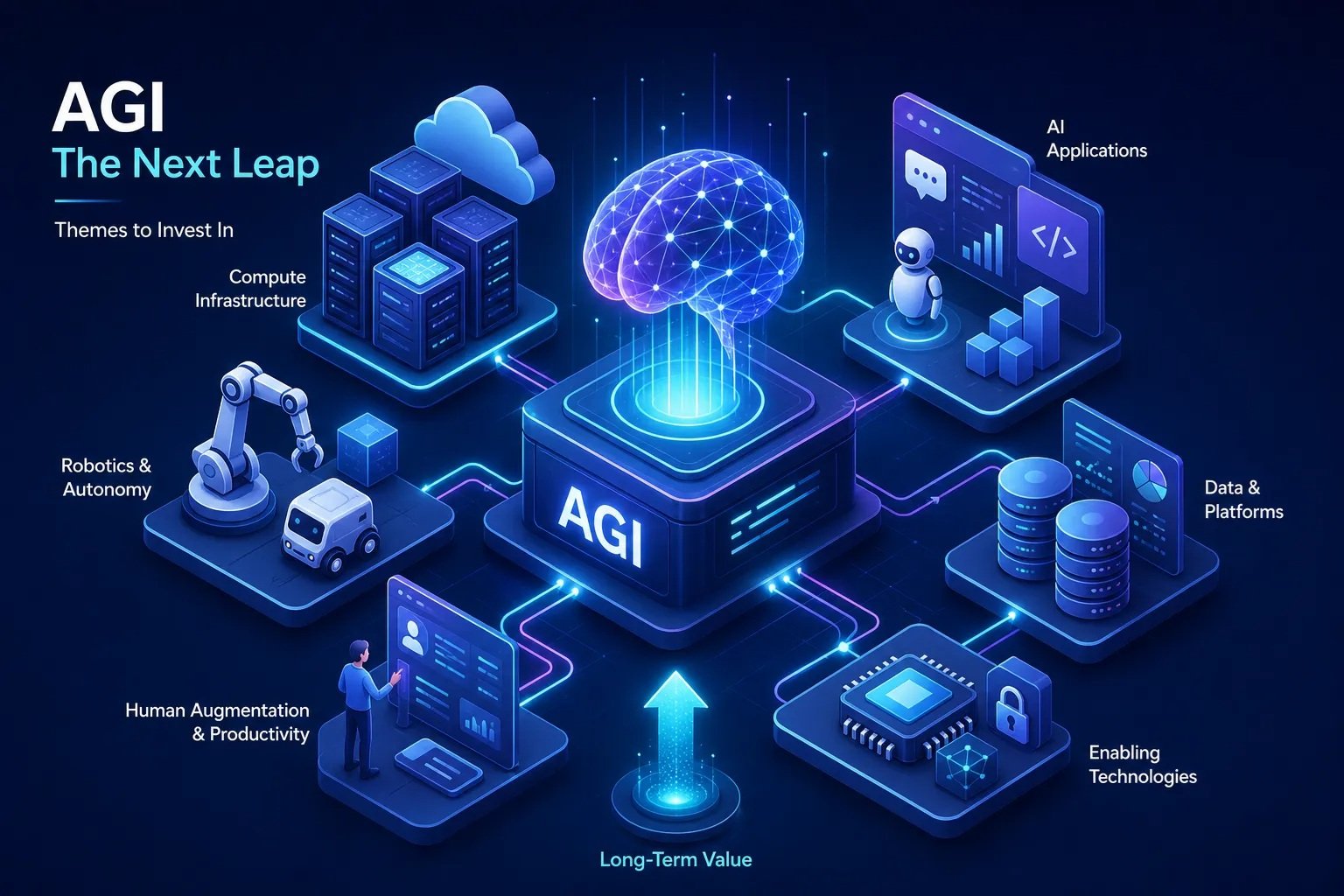
The most accessible, lower-variance exposure to AGI development comes from enabling infrastructure: semiconductor designers and manufacturers, cloud computing providers, data-center real estate investment trusts, and energy companies supplying power to AI workloads. These businesses benefit regardless of which specific AGI architecture eventually wins. The “shovel-sellers during a gold rush” is a widely used analogy in investing precisely because enabling-layer companies tend to capture more consistent revenue than those betting on a single downstream winner.
ETFs and funds worth researching
For European retail investors, one specific option worth researching is the WisdomTree AI Infrastructure UCITS ETF (ticker WAGI/XLAI, ISIN IE000XHZP7D3), listed in euros on Xetra and Borsa Italiana. According to WisdomTree, its holdings span data centers, semiconductor manufacturers, networking companies, cloud providers, and power infrastructure, with major positions including Nvidia, TSMC, ASML, Broadcom, SK Hynix, and AMD. Its total expense ratio is 0.50%, and it launched in June 2026, so its live track record is short.
Alternative options in this space include the iShares AI Infrastructure UCITS ETF and the Global X AI Semiconductor and Quantum UCITS ETF, though concentration levels and definitions of “AI infrastructure” vary across funds. Always verify UCITS status, PRIIPs/KID availability, and fund domicile before trading.
Software, biotech, and further up the stack
Further up the stack are software companies building AGI-adjacent products and industries that stand to gain from AI-driven productivity: biotech firms using AI for drug discovery, fintech platforms automating financial analysis, and enterprise software companies embedding AI agents into workflows. The caution here is that valuations in this layer tend to reflect optimism about a future that hasn’t arrived yet. Position sizing matters more than sector selection when you’re buying into that kind of forward-looking enthusiasm.
How to size speculative positions without derailing your plan
A common rule of thumb in personal finance is to keep speculative thematic positions to around 5% to 10% of a beginner’s total portfolio. A more permissive upper limit is 10% to 20%, provided the remaining 80% to 90% stays in diversified, long-term holdings. One starting template many investors use: 70% to 80% in broad market index funds such as global or all-world ETFs, 10% to 20% in sector-specific tilts like technology, and 5% to 10% in higher-risk thematic plays such as AGI-adjacent stocks or infrastructure ETFs. These ranges are guidelines, not rules, and your own risk tolerance and timeline should shape your final allocation. You can model how different allocation splits affect your long-term growth using Invest Education’s free compound interest calculator.
Investors also need to account for the tax layer, and the specifics vary significantly by country. In the US, dividends and capital gains treatment depends on account type and holding period. International investors face additional complexity: withholding taxes on dividends from foreign-listed equities, local capital gains rules, and treaty-specific rates all interact. Rather than rely on general figures that may not reflect your situation, we strongly recommend checking with your country’s tax authority or a qualified tax advisor before increasing your AGI-themed exposure. Running your projected returns through Invest Education’s retirement calculator first also helps you check whether the added risk moves your long-term outcome meaningfully or just adds noise to your plan.
The emotional side of this matters too. Thematic investing attracts attention during hype cycles and then tests patience during the quiet years in between. The best structural protection for a beginner investor is automating contributions to the core portfolio so that AGI exposure stays proportional. If a thematic position grows to an uncomfortable size because of price appreciation, rebalancing back to your target allocation isn’t a missed opportunity. It is the plan working exactly as intended.
Where to take this from here
Artificial general intelligence is one of those topics that seems to demand certainty: either it’s arriving in three years and will change everything, or it’s thirty years away and not worth thinking about yet. Both framings miss the point. The honest answer is that we are watching a long, uneven, genuinely uncertain transition, and the wisest thing a beginner investor can do is hold that uncertainty lightly rather than bet heavily on one version of the future.
Keep the speculative slice of your portfolio small enough that being wrong won’t hurt you. Keep the core diversified and growing. And keep learning, because the field is moving fast enough that what you understand today about AGI will look meaningfully different in two or three years. Invest Education offers beginner guides and free financial calculators. Start with our compound interest calculator to model your core allocation, then revisit the thematic layer once the foundation is solid.