
Last Updated on October 22, 2026
The national average savings account APY sits at about 0.37%, according to US News and FDIC-based trackers, while the best high-yield savings accounts in October 2026 reach up to 4.50%, according to Fortune. That’s not a rounding error. It’s roughly 12 times more interest on money you’re already setting aside.
Many beginners feel unsure about the process of switching accounts and never make the move, even when they know a better rate exists. This guide covers what a high-yield savings account actually is, how APY math works, what to look for beyond the headline number, and how FDIC protection keeps your deposits safe. By the end, you’ll know which account type fits your situation and what to do next.
What a high-yield savings account is (and what it isn’t)
A high-yield savings account is a deposit account at an FDIC-insured bank or NCUA-insured credit union that pays a significantly higher rate than a traditional savings account. The national average for standard savings hovers around 0.37%, according to US News, while competitive accounts routinely pay 4.00% or more. That spread exists primarily because most high-yield accounts are offered by online banks, which carry far lower overhead than traditional brick-and-mortar institutions.
Without a branch network to maintain, online banks pass those cost savings back to depositors through higher rates. This isn’t a promotional gimmick or a hidden trade-off. It’s simply a different business model.
One thing to be clear about: a high-yield savings account is not an investment. The rate is variable and set by the bank, not tied to market performance. Your principal carries no market risk. That makes a high-yield savings account the right tool for specific jobs, primarily an emergency fund or a near-term savings goal, but the wrong tool for long-term wealth building on its own.
How APY and compounding actually work
What APY means and why it matters
APY stands for Annual Percentage Yield. It represents the actual return you earn over one year, including the effect of compounding. This is the number to compare across accounts, not the nominal interest rate, because APY is the honest figure after compounding is factored in.
Compounding frequency makes a real difference, even if it’s modest. A 4.00% nominal rate compounded monthly produces an APY of roughly 4.074%. Daily compounding pushes it to about 4.081%. On a $10,000 balance at 4.00%, monthly compounding earns about $407.42 in a year; daily compounding produces roughly $408.08, according to Bankrate. The gap seems small now, but it grows meaningfully over time and at larger balances. Invest Education’s free compound interest calculator lets you run your own numbers in seconds without touching a spreadsheet.
Watch out for the promotional rate trap
The bigger risk for beginners is the promotional rate trap. A bank advertising 6.00% APY might apply that rate only for the first three months, then drop to 3.00% for the remaining nine. That structure produces an effective first-year yield of roughly 3.74%, not 6.00%. Always look at the post-promotion APY, the balance caps, the direct deposit requirements, and the introductory timeline before treating any headline rate as the real one.
What to compare beyond the headline rate
Fees to watch for
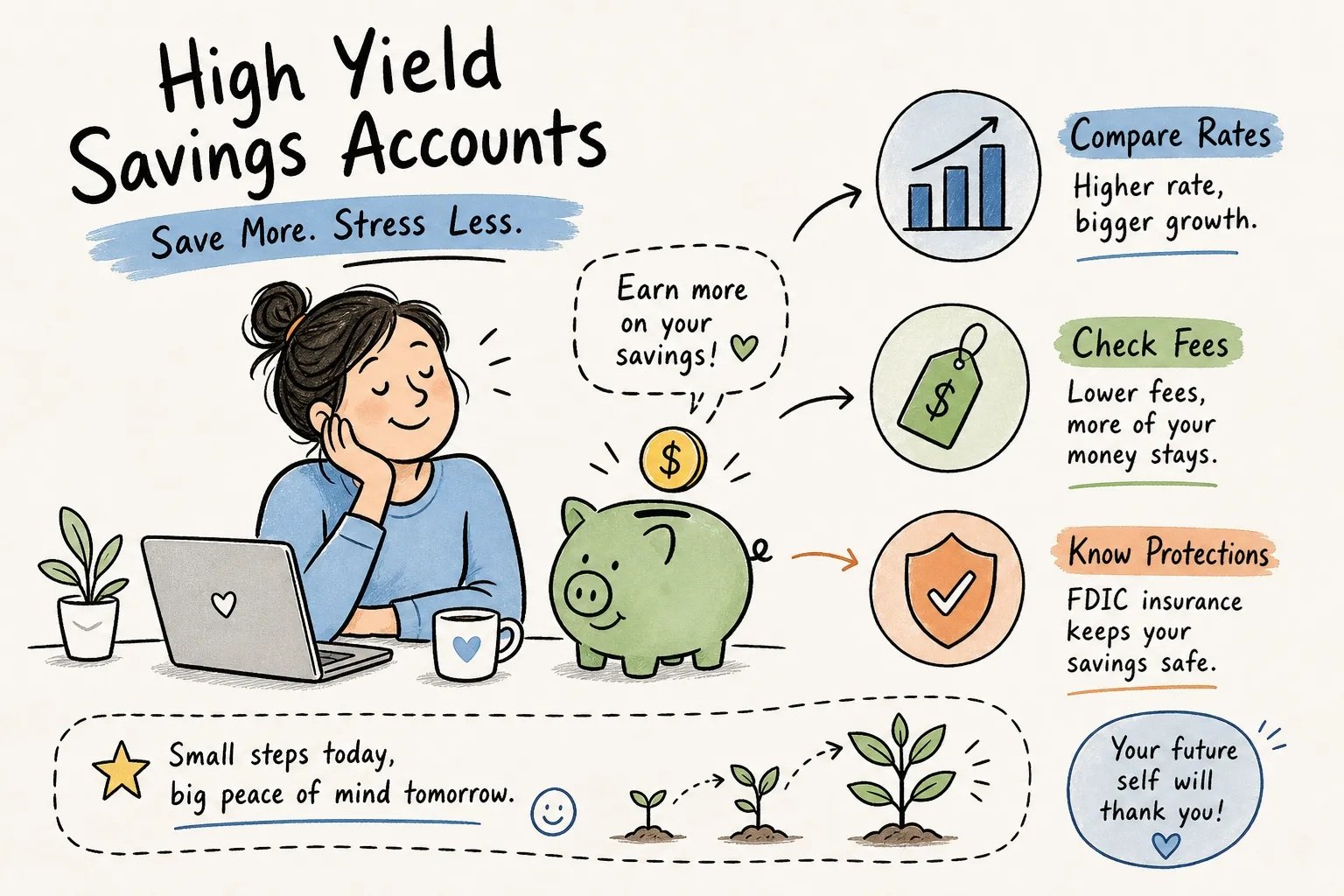
Most top high-yield savings accounts charge no monthly maintenance fee, but that doesn’t mean they’re fee-free. Other accounts charge for outgoing wire transfers, expedited transfers, or excess withdrawals. Always read the full fee schedule, not just the maintenance line.
Withdrawal limits and minimum balances
Withdrawal limits are another area beginners frequently overlook. The Federal Reserve removed the Regulation D six-transfer cap in 2020, but many banks still enforce their own six-withdrawal limit per month as internal policy. Accounts including Axos, E*TRADE Premium Savings, EverBank, and Capital One 360 all cap transfers at six per statement cycle. Exceeding the limit can trigger fees or account restrictions. If this account will serve as your emergency fund, confirm the bank’s actual withdrawal policy before you need the money in a hurry.
Minimum balance requirements can also affect your real APY. CIT Bank Platinum Savings requires a $100 minimum to open, and its highest advertised rate applies only to balances of $5,000 or more, according to CNBC. If you can’t consistently maintain those thresholds, you may earn a rate far below the one that attracted you in the first place. Compare accounts on equal terms before committing, not just by the advertised figure.
How your deposits are protected: FDIC, NCUA, and the fintech caveat
FDIC insurance covers up to $250,000 per depositor, per insured institution, per ownership category, according to the FDIC. Individual and joint accounts are treated as separate ownership categories, which creates useful flexibility. Accrued interest counts toward the applicable limit.
The ownership category distinction matters in practice. Moving the excess to a separately insured institution restores full coverage without costing you anything. You can use the FDIC’s BankFind tool to confirm that a target institution is independently insured before transferring funds.
FDIC and NCUA protection doesn’t extend to stocks, bonds, mutual funds, money market mutual funds, or annuities, even when purchased through a bank. Coverage applies only against the failure of the insured institution itself. One area that catches beginners off guard: some fintech apps and neobanks market “high-yield savings” products without being FDIC-insured banks themselves. Your funds may be protected through a partner bank arrangement, but coverage depends on how balances are allocated and whether you already hold deposits at that same underlying institution. Always verify the actual insured bank, not just the app or brand name, before depositing money.
HYSA vs. money market account vs. short-term CD: which fits your goal
A high-yield savings account is the default choice for an emergency fund. The rate is variable but competitive, there’s no lock-up period, and transfers to your checking account are generally processed within one to three business days, depending on the bank. For the three to six months of living expenses most financial educators recommend keeping in reserve, a HYSA is hard to beat on the combination of access, yield, and simplicity.
A money market deposit account makes sense when you want savings-level yield with checking-style access. Many money market accounts include check-writing privileges, a debit card, or ATM access, making them useful when you need to make direct payments from your savings balance. The trade-off is that money market accounts often require a higher minimum balance and may tier their rates based on how much you hold, which can reduce the effective APY for smaller depositors.
A short-term CD works best when you know the exact date you’ll need the money and want to lock in a rate before it falls. The rate is fixed for the term, protecting you in a declining-rate environment. A CD ladder, splitting savings across CDs with staggered maturity dates, captures some fixed-rate benefit while giving you predictable access points throughout the year. For emergency savings you might need without warning, keep at least a portion in a HYSA rather than locking everything into a CD.
One broader point is worth stating directly: a high-yield savings account is not a substitute for investing. If your emergency fund is covered and you have no near-term cash needs, money you can leave untouched for five or more years is likely better deployed in low-cost index funds or ETFs. A 4.50% HYSA rate can look close to flat in real terms during periods of elevated inflation, while long-term equity returns, averaging roughly 10% annually for broad U.S. index funds over long historical periods, have outpaced savings rates by a wide margin. Invest Education’s beginner guides on ETFs and index funds cover that next step in plain language.
How to open your first high-yield savings account
Before applying, gather three pieces of information:
- The current APY and whether it’s promotional or standard
- The full fee schedule, including charges beyond the monthly maintenance line
- The FDIC or NCUA status of the institution
Cross-check each option against the same criteria so you’re comparing accounts on equal terms. Then run your expected balance through Invest Education’s compound interest calculator to see projected earnings over 12 months before you commit.
The application itself is straightforward. You’ll need a government-issued ID, your Social Security number, and a linked checking account to fund the initial deposit. Once the account is open, set up an automatic transfer from your paycheck or checking account. Building the habit of consistent contributions matters more than the size of your opening balance.
The next step is simpler than you think
The rate gap between a standard savings account and a high-yield savings account isn’t theoretical.
The process is more manageable than it looks. Understand how APY is calculated, read the full fee schedule, confirm FDIC protection, and match the account type to your actual goal. Invest Education offers free tools including a compound interest calculator. Start there, pick the account that fits your goal, and transfer your first dollar before the week is out.